Morrow connects your own ChatGPT and Claude directly to the courses you teach, design, build, audit, improve, or support.

You should not have to wait for your institution to buy and roll out a separate course assistant.

Morrow lets you use ChatGPT, Claude, or Gemini to build and review work in Canvas, Moodle, or Blackboard.

Morrow is and always will be free and open source.

  • Plan courses and create approved lessons, activities, discussions, assignments, and modules.
  • Build, review, and improve New Quizzes and Item Banks, down to each question and setting.
  • Audit and remediate accessibility at scale, map curriculum, and prepare accreditation evidence.
  • Compare and update dozens of courses, then verify each approved change against what the LMS saved.
Instructor

Nursing 210 starts in two weeks and I inherited it from someone who left. I need to know how bad the accessibility is before students see it.

Your Assistant Using Morrow

I read all 84 pages, 22 assignments, 11 discussions and the 60 quiz questions. 31 images have no description, 9 tables have no header row, and 6 quiz images are unlabelled. Most of it is on the four lab pages. Your 12 videos still need a person to watch the captions.

Instructor

Start with the lab pages. Show me what you would change before you touch anything.

Your Assistant Using Morrow

Here are the four lab pages beside the rewrite: 14 image descriptions written from what each image actually shows, and the two data tables given proper headers. Your wording and the lab-safety note are untouched.

Instructor

Good. Do those, then keep going through the rest of the course.

Your Assistant Using Morrow

The four lab pages are saved and I checked each one afterwards. I am working through the remaining 31 findings now. Nursing 210 will be clean before your students get there.
Access With Privacy in View

Course access should not expose student identities to your assistant.

Morrow first confirms the course and builds a complete identity list for the records it will read. Before course information reaches your assistant, it replaces names, parts of names, email addresses, usernames, and school or course account IDs with labels such as Student A1. If it cannot identify and protect every student in those records, it stops.

See How Morrow Protects Student Identity

Your course sign-in stays in Chrome.

Passwords, cookies, and sign-in details do not go to the Morrow app or your assistant.

Known student identifiers become course labels.

Morrow replaces known student identifiers in the course records it sends to your assistant. Names or files you provide directly to the assistant bypass Morrow.

The label stays with the course.

Your assistant can refer to Student A1 later. Morrow matches that label back to the student only within the same course.

Start with the course access you already have.

Morrow gives educators direct tools for the courses they already manage. Sign in to Canvas or Moodle as you normally do, and your assistant can work with the same courses you can open. Morrow never gives anyone new access. Blackboard starts with a connection your administrator sets up.

Bring course work to the assistant you choose.

A general chat cannot open your courses on its own. Morrow connects the assistant you already use to the courses your account can open, and only to the ones you select.

You keep the assistant you already use.

Keep working in the assistant you know. Ask ChatGPT, Claude Desktop, Claude Code, or Gemini CLI to use Morrow when you need course information.

What You Get Your institution does not have to buy an assistant product for you to start.

Compare many courses at once.

Choose the courses and the pages, assignments, discussions, quizzes, or dates to compare. Your assistant names anything it could not read.

What You Get Compare sections, trace one outcome across a program, or find the same broken table in many courses.

Turn findings into useful work.

Your assistant can use the course information to write a study guide, build a chart, or draft a message. Morrow connects the assistant to your courses.

What You Get A result you can review and use.

Choose. Ask. Review.

Choose the courses, ask for the work, and review the result. Morrow checks each approved change against the course and tells you when something still needs attention.

  1. 1

    Choose the courses and sections.

    Your assistant can use only courses your account can open.

  2. 2

    Ask a clear question.

    Ask which students missed an assignment, where deadlines overlap, or which lessons need clearer image descriptions.

  3. 3

    Review what supports the answer.

    Open the pages, assignments, or discussions that support a finding before you act.

  4. 4

    Approve only the changes you want.

    Compare the current and proposed versions. Afterward, your assistant checks each changed item in the course.

Continue from your phone.

Use ChatGPT Remote or Claude Code Remote Control while Morrow runs on your computer. Keep the computer awake and online, Morrow Bridge open, and a Canvas or Moodle tab signed in. An assistant’s permission prompt is not Morrow approval.

How Remote Use Works

Get started with Morrow.

Download Morrow for Mac or Windows. The setup guide helps you install Morrow Bridge and connect your assistant. Then open a course you teach or manage.

MacWorks on Macs with Apple silicon
WindowsWorks on Windows 10 and Windows 11

See the Three-Stage Setup, or choose your computer on the Download Page.

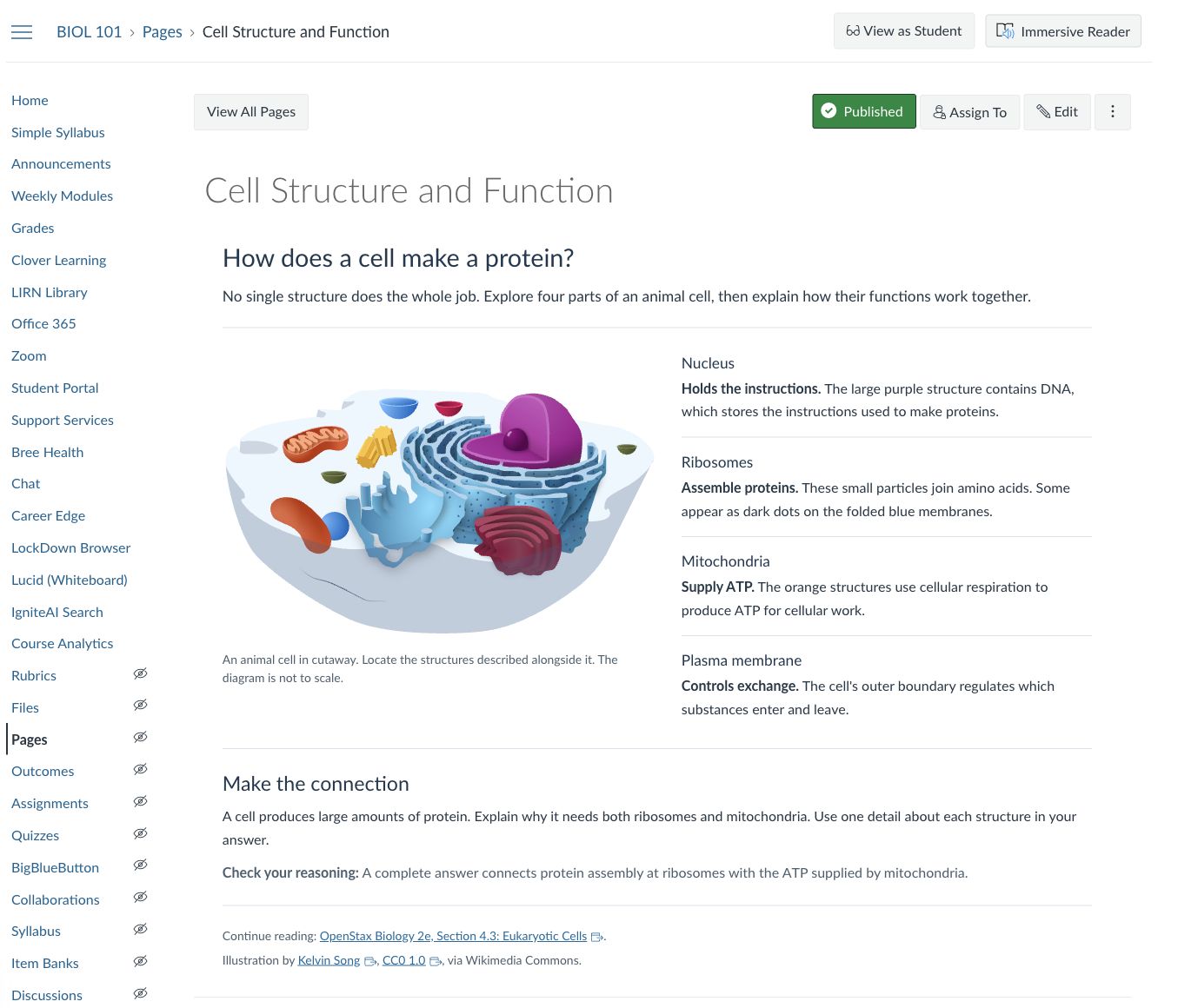
Your assistant can check a course page as Canvas saved it.

Review the page Canvas saved. A person must also test the learner view for accessibility.

A published Canvas page named Cell Structure and Function in the BIOL 101 course. It shows the course menu, a heading, a labelled cell diagram with a description below it, four named cell structures, and a short student task.
A Canvas page. Morrow can read its headings, image descriptions, tables, instructions, and links. It does not show a Morrow change.